Beyond the Glass: Rethinking What Primate Self-Recognition Actually Measures
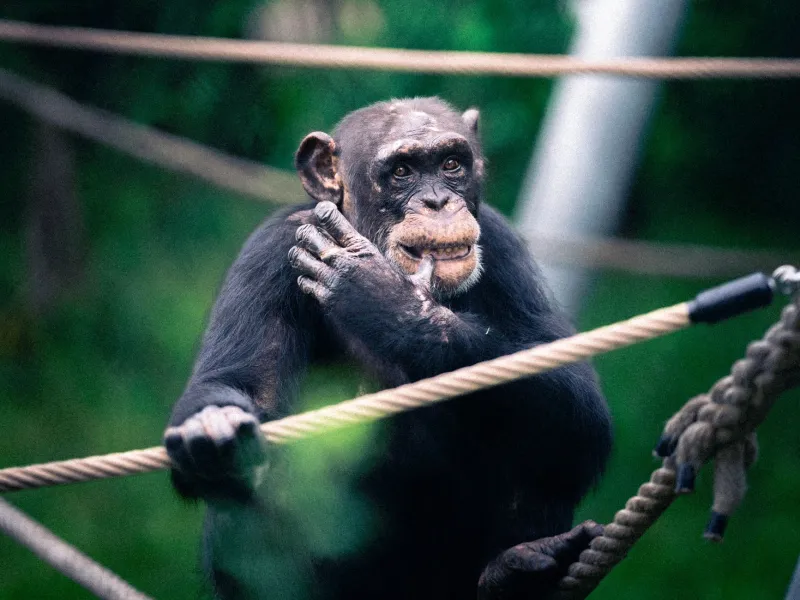
In 1970, psychologist Gordon Gallup Jr. introduced an elegantly simple experiment that would reshape the study of animal minds for the next half century. He placed chimpanzees in front of mirrors, marked their faces with odorless dye, and observed whether the animals touched the marked spots—behavior interpreted as evidence that they recognized their own reflection. The mirror self-recognition (MSR) test was born, and with it, a framework that would come to define how scientists categorize primate intelligence.
The test's logic is intuitive: if an animal understands that the creature in the mirror is itself, that recognition implies a form of self-concept. For years, passing the MSR test became something of a membership card for entry into the so-called "elite" of animal cognition. Great apes cleared the bar. Monkeys, almost universally, did not. The implications seemed profound.
But science rarely stays simple for long.
How the Test Became a Gold Standard
The MSR test gained its authoritative status partly because of what it appeared to measure and partly because of how neatly it sorted species into cognitive tiers. Chimpanzees, bonobos, orangutans, and gorillas—with some notable individual variation—demonstrated mirror-directed behavior consistent with self-recognition. Macaques and capuchins, by contrast, typically responded to their reflections as though encountering a stranger.
This hierarchy aligned conveniently with existing assumptions about primate intelligence and evolutionary proximity to humans. Researchers, science communicators, and educators embraced the test as a reliable shorthand for consciousness, and it filtered into textbooks, museum exhibits, and popular science writing across the United States and beyond.
The appeal was also methodological. The MSR test is observable, repeatable, and produces data that can be compared across studies and institutions. In a field where measuring something as abstract as self-awareness is genuinely difficult, that kind of empirical tractability is valuable.
The Cracks in the Mirror
In recent years, however, a more skeptical chorus has emerged within the primatology community. Researchers have identified several fundamental problems with treating MSR performance as a direct proxy for self-awareness.
First, the test is heavily biased toward species that rely primarily on vision. Many primates—and indeed many highly intelligent animals—navigate their social worlds through olfaction, audition, and tactile sensation. A mirror offers no information through those channels. Asking a scent-oriented animal to recognize itself visually may be roughly analogous to asking a human to identify themselves by a sound they cannot hear.
Second, motivation matters enormously. Passing the MSR test requires not only self-recognition but also sufficient curiosity about the mark on one's face to touch it. Animals that groom less frequently, are more stoic about minor physical changes, or simply find the experimental setting stressful may fail the test for reasons entirely unrelated to self-concept.
A striking illustration of this problem came from studies with rhesus macaques. When researchers trained macaques to use mirrors for navigation and then applied the standard mark test, some animals demonstrated behaviors consistent with self-recognition—despite decades of literature classifying this species as MSR-negative. The finding did not necessarily mean macaques had been misclassified. It meant the test's design was influencing its results in ways that had gone underexamined.
What the Data Cannot Tell Us
Perhaps the most significant limitation of the MSR test is philosophical rather than methodological. Self-awareness, as humans experience it, is a layered and multidimensional phenomenon. It encompasses bodily self-perception, autobiographical memory, awareness of one's mental states, and the capacity to model oneself as an entity distinct from others. Touching a mark on one's face in response to a mirror image may reflect some of these dimensions—but it almost certainly does not reflect all of them.
When a chimpanzee passes the mirror test, researchers can reasonably conclude that the animal processes visual self-information in a sophisticated way. What they cannot conclude is that the chimpanzee possesses a rich interior life equivalent to human self-consciousness, or that a monkey failing the test lacks any form of self-representation whatsoever. The gap between what the test measures and what it is often taken to mean has grown increasingly difficult to ignore.
Alternative Approaches Gaining Ground
The limitations of the MSR test have prompted researchers to develop more multidimensional approaches to studying primate cognition and identity. Several of these methods are now producing results that complicate and enrich the picture the mirror test painted.
Body-ownership paradigms examine whether primates respond differently to stimuli applied to their own bodies versus those applied to objects or other individuals, probing proprioceptive self-awareness without relying on visual recognition.
Social eavesdropping studies investigate whether primates track their own reputations within group hierarchies, suggesting a form of social self-modeling that does not require mirror interaction at all.
Metacognitive tasks ask animals to report their own uncertainty about information they have or have not been given—a capacity that implies awareness of one's own mental states. Several primate species, including rhesus macaques, have demonstrated rudimentary metacognitive abilities in controlled laboratory settings.
Longitudinal behavioral profiling tracks how individual primates respond to novel situations over time, building evidence for consistent self-regulatory patterns that may reflect stable internal representations of the self.
None of these approaches is without its own interpretive challenges. But collectively, they are pushing the field toward a richer, more nuanced understanding of primate cognition—one that does not hinge on a single behavioral response to a piece of reflective glass.
What This Means for Primate Science
The reassessment of the mirror self-recognition test carries real implications for conservation and welfare policy, not just academic theory. Classification systems that sort species into cognitively "advanced" and "basic" categories based on MSR performance have historically influenced decisions about habitat protection, captive management standards, and which animals are considered worthy of legal protections.
If those classifications rest on a flawed or incomplete instrument, the downstream consequences matter. A species deemed cognitively simple on the basis of mirror test failure may be receiving inadequate environmental enrichment in captivity, or insufficient policy attention in the wild.
At the Iowa Primate Learning Center, the evolving science around primate cognition reinforces a core principle: understanding these animals requires methodological humility. The mirror test was a genuine contribution to science—a tool that opened important questions about animal minds. But the most productive scientific instruments are those that generate new questions as readily as they produce answers.
The mirror, it turns out, reflects less than we once assumed. And that, for primatology, may be exactly the kind of discovery that moves the field forward.