The Matriarchs Who Remember Everything: How Elder Female Primates Shape Survival, Culture, and Longevity
In most of the animal kingdom, reproduction defines biological purpose. When fertility ends, the evolutionary rationale for continued survival becomes, from a strictly gene-centric perspective, ambiguous. Yet across several primate species — and most dramatically in humans — females routinely outlive their reproductive years by substantial margins, remaining active, socially influential, and ecologically indispensable long after they have produced their last offspring.
This is not a biological accident. It is, many researchers now believe, an adaptation — and one with profound implications for understanding how knowledge moves through generations, how social groups maintain resilience under environmental pressure, and why some species live as long as they do.
1. The Grandmother Hypothesis: An Old Idea With New Evidence
The theoretical framework most often invoked to explain post-reproductive longevity in primates is the Grandmother Hypothesis, first articulated systematically by anthropologist Kristen Hawkes and colleagues in the 1990s. The core argument is elegant: if a female who has ceased reproducing can substantially increase the survival and reproductive success of her grandchildren by providing food, protection, and knowledge, her genes — shared with those grandchildren — may propagate more effectively than if she continued attempting to reproduce herself at diminishing physiological capacity.
The hypothesis was developed primarily in the context of human evolution, where post-menopausal lifespan is dramatic and well-documented. But accumulating evidence suggests the underlying dynamic operates, in modified forms, across several non-human primate taxa as well.
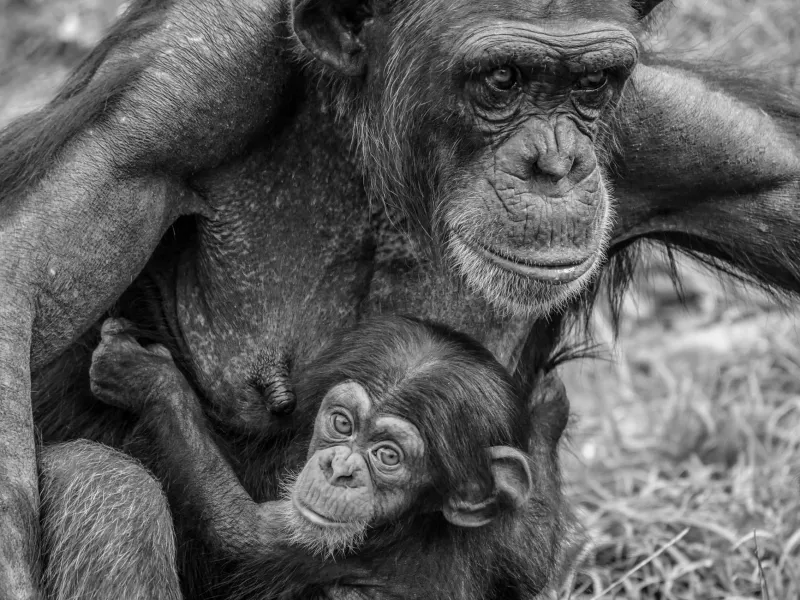
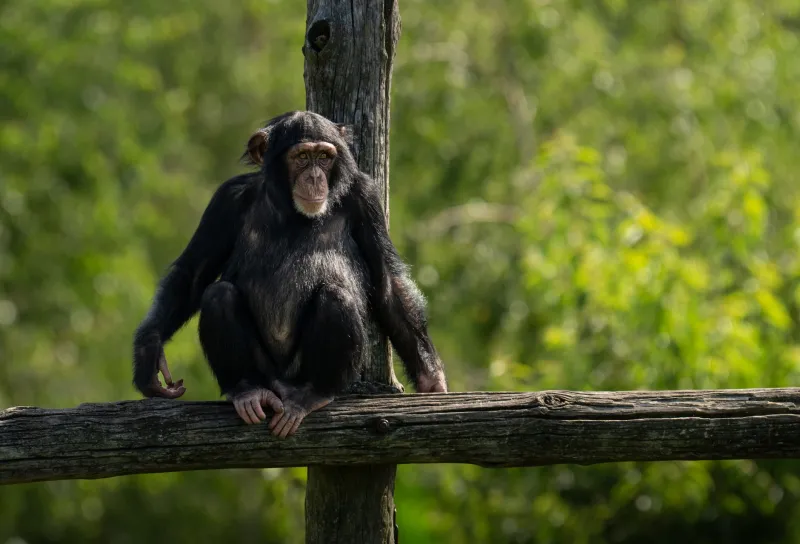
Longitudinal data from the Gombe Stream Research Center in Tanzania — where chimpanzees have been individually tracked for more than five decades — show that juvenile chimpanzees with living maternal grandmothers have measurably higher survival rates than those without. The mechanism is not fully resolved, but behavioral observation suggests grandmothers contribute through direct food sharing, protective vigilance, and the transmission of ecological knowledge that younger mothers have not yet accumulated.
2. Chimpanzee Grandmothers: The Knowledge Keepers of the Forest
Among chimpanzees, elder females occupy a distinctive social position. They are rarely the most dominant individuals in a community — that role typically belongs to adult males — but their influence on group decision-making and cultural continuity is increasingly recognized as substantial.
Long-term field research across multiple African study sites has documented elder female chimpanzees demonstrating foraging techniques to younger group members with a specificity that suggests active instruction rather than passive modeling. At Bossou in Guinea, researchers observed older females using stone tools to crack oil palm nuts with a precision that younger individuals, including their own offspring, visibly attended to and attempted to replicate. The transfer of this skill across generations represents a form of cultural transmission that parallels, in structure if not complexity, human apprenticeship.
Perhaps most striking is the role elder females appear to play during environmental disruption. Studies of chimpanzee communities responding to seasonal food scarcity or habitat alteration have noted that older females are disproportionately likely to lead groups toward alternative food sources — resources that younger adults, lacking decades of ranging experience, may not know exist. This ecological memory, accumulated over a lifetime of observation, becomes a community asset during the periods when it is most needed.
3. Bonobo Elders and the Architecture of Social Peace
In bonobo society, the influence of elder females takes a different but equally consequential form. Bonobos are distinguished among the great apes by the exceptional social power wielded by adult females, who form strong coalitions capable of counterbalancing male physical advantage. Within this already female-centered social structure, elder females occupy positions of particular authority.
Research conducted at sanctuaries housing rescued bonobos — including facilities in the Democratic Republic of Congo — has documented elder females actively mediating conflicts between younger group members, intervening in aggressive encounters, and appearing to set behavioral norms that shape group-level social climate. Younger bonobos, particularly juveniles, preferentially affiliate with elder females during periods of social tension, a pattern consistent with the hypothesis that these individuals function as social anchors.
Because bonobo society is structured around the management of conflict through social bonding rather than dominance enforcement, the loss of an elder female can produce measurable disruption to group cohesion. Facilities that have documented the deaths of long-term resident elder females report subsequent increases in agonistic behavior and social instability — a natural experiment in the cost of losing institutional social memory.
4. Orangutan Matriarchs: Solitary but Irreplaceable
Orangutans present a compelling case study precisely because they challenge the assumption that grandmother effects require highly gregarious social structures. Orangutans are the most solitary of the great apes, with social organization built around loosely overlapping home ranges rather than cohesive communities. Yet even here, elder females appear to play a distinctive role.
Longitudinal research in Borneo and Sumatra has documented that elder female orangutans maintain the largest and most complex mental maps of their home ranges — tracking the fruiting schedules of hundreds of tree species across landscapes that can span tens of square kilometers. During years when primary food sources fail, these individuals demonstrate navigational decisions that younger animals do not replicate, leading observers to propose that elder females function as living ecological databases.
Young orangutans, who remain with their mothers for the longest juvenile dependency period of any non-human primate — up to eight years — appear to acquire much of their ecological knowledge through extended association with experienced mothers and, where range overlap permits, elder female relatives. The duration of this dependency itself may be partly explained by the sheer volume of learned information required to survive in a complex, variable tropical forest environment.
5. Implications for Human Longevity and Intergenerational Learning
The comparative study of post-reproductive primate females carries implications that extend into human biology and social science. If extended post-reproductive lifespan in primates correlates with the ecological and social complexity of the environments those species inhabit, it suggests that human longevity may have co-evolved with the increasing complexity of human culture — that we live longer, in part, because there is more worth knowing and more worth teaching.
This framing recontextualizes aging from a biological failure to a social resource. It also raises pointed questions about the conditions under which elder knowledge is effectively transmitted — and the costs incurred when social structures that facilitate transmission are disrupted.
For conservation, the implications are direct. Poaching and habitat encroachment disproportionately affect older, larger animals, removing precisely the individuals whose accumulated knowledge is most difficult to replace. A chimpanzee community that loses its elder females loses not just reproductive capacity but ecological memory — a form of cultural capital that may take generations to rebuild, if it is rebuilt at all.
The Science of Remembering Together
The elder females at the center of these research findings are not passive beneficiaries of group tolerance. They are active contributors to group survival, cultural continuity, and social stability in ways that behavioral science is only beginning to quantify. Their existence challenges reductive models of evolutionary fitness and invites a more sophisticated understanding of what it means for a life to have biological value.
For institutions committed to primate education and conservation, communicating this complexity to American audiences — many of whom encounter primates primarily through zoo visits or nature documentaries — represents both an opportunity and an obligation. The matriarchs of the forest have much to teach. The task is making sure their lessons reach the people who have the most power to protect them.